Intramuscular vs Subcutaneous Testosterone Injections
What clinical studies say about intramuscular and subcutaneous testosterone, including pharmacokinetics, patient comfort, product formulation and device design.
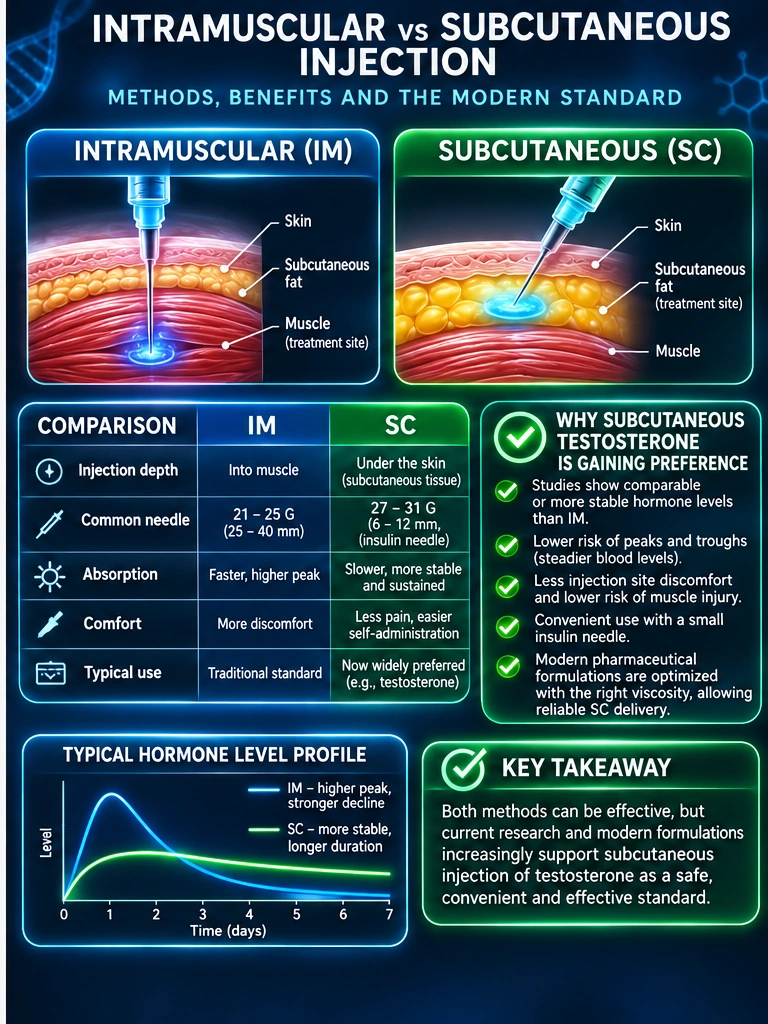
Click the infographic to view it at full size.
Two delivery routes
Intramuscular (IM) injections deliver medicine into muscle. Subcutaneous (SC) injections deliver it into tissue beneath the skin. Both routes can achieve systemic exposure, but absorption depends on the specific testosterone ester, oil vehicle, dose volume and injection schedule.
What comparative evidence shows
A 2022 review concluded that selected SC testosterone regimens can produce mean serum testosterone levels and pharmacokinetics comparable to IM therapy. With appropriate instruction, some patients find SC self-administration easier and more comfortable. However, the comparative evidence remains limited and does not establish that SC is universally superior.
An important exception
In a randomized crossover study of 20 men using long-acting testosterone undecanoate, SC and IM pharmacokinetics were broadly similar, but pain at 24 hours was greater after SC injection; more participants preferred IM. Results with one preparation cannot be generalized to every formulation.
The role of viscosity and needle design
Oil composition, viscosity, concentration, injection volume and device engineering all influence how easily a solution passes through a small needle. An approved SC testosterone enanthate product, XYOSTED, uses a dedicated pressure-assisted autoinjector. That does not mean every testosterone product can be injected through an insulin needle or that IM-labelled products can be switched to SC without clinical guidance.
Are hormone levels always steadier?
Some SC schedules can offer consistent testosterone exposure, but peak-to-trough fluctuations also depend on ester, dosing interval and formulation. It would be misleading to claim that every SC injection gives smoother levels than every IM injection.
Safety and clinical use
Testosterone treatment should be considered only for an appropriate medical indication and monitored for blood pressure, hematocrit, symptoms and other relevant risks. Never change the route of a prescribed injectable product without consulting its prescribing clinician and official product instructions.
Conclusion
SC testosterone is an increasingly recognized option for selected patients and approved products, not a universal new pharmaceutical standard replacing IM therapy. The strongest message is individualized, evidence-based formulation and route selection.
Scientific references
- Testosterone Therapy With Subcutaneous Injections: A Safe, Practical, and Reasonable Option
- Pharmacokinetics and Acceptability of Subcutaneous Injection of Testosterone Undecanoate
- SC vs IM testosterone: pilot crossover study
- XYOSTED official prescribing information
Educational research commentary only. Not medical advice or instructions for self-administration. Clinical decisions require an appropriately qualified professional.