Muscle Memory: Why Previously Trained Muscles Come Back Faster
TigerBlood Science · Where Science Meets Real-World Experience
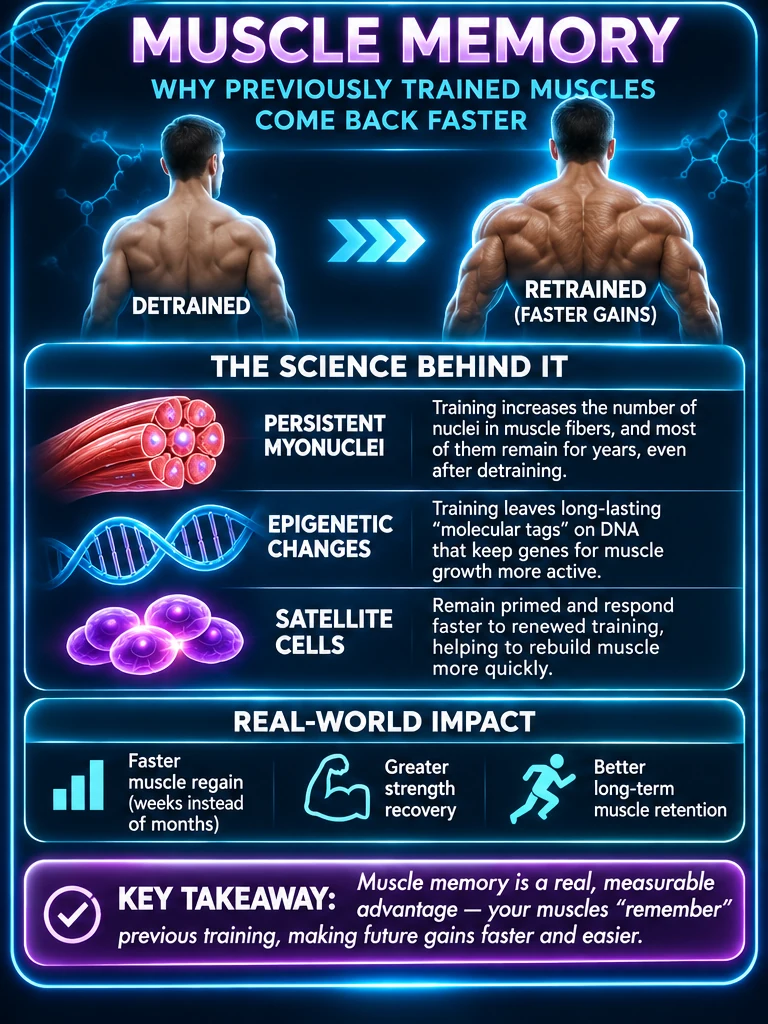
Why can someone who once trained consistently often rebuild strength and muscle size faster than a complete beginner? The term muscle memory describes several overlapping adaptations, not a single biological switch.
1. Two kinds of memory: neural and muscular
Early strength gains rely heavily on improved motor learning: recruiting muscles more effectively, coordinating movements and refining technique. These skills can return relatively quickly after a break. Muscle size also adapts through changes within muscle fibers and their supporting cells.
2. Myonuclei: a promising but still debated explanation
Resistance training can add nuclei to muscle fibers through the contribution of satellite cells. Some animal research suggests these nuclei may persist through periods of muscle shrinkage, potentially supporting later regrowth. The duration and functional importance of myonuclear retention in humans remain under investigation. It would be premature to say that every training-induced nucleus remains for life.
3. Epigenetic changes and retraining
Human studies have identified training-associated changes in DNA methylation and gene expression, some of which may be retained or reappear with retraining. These findings are intriguing, but they do not prove that an individual will regain muscle in a fixed number of weeks.
4. Satellite cells and tissue adaptation
Satellite cells help maintain and repair skeletal muscle and may contribute nuclei during growth. Their behavior varies with age, training history, exercise stimulus and individual biology. Tendons, connective tissue and cardiovascular fitness may not recover at the same rate as familiar lifting skills.
5. What this means in the gym
After a training interruption, previously practiced lifts may feel familiar before the muscles and connective tissues are ready for previous loads. A progressive return, sufficient protein, sleep and sensible volume are more useful than trying to reproduce old personal records immediately. The speed of recovery varies with detraining duration, illness or injury, age and training history.
6. What muscle memory does not prove
Muscle memory is not evidence that a peptide, hormone or anabolic drug is necessary for regaining previous fitness. Most of the practical benefit comes from prior training adaptations and a consistent return to exercise.
Research and further reading
- Seaborne RA et al. Human skeletal muscle possesses an epigenetic memory of hypertrophy. Scientific Reports (2018). DOI.
- Gundersen K. Muscle memory and a new cellular model for muscle atrophy and hypertrophy. Journal of Experimental Biology (2016). DOI.