Total vs Free Testosterone: Why Both Measurements Matter
TigerBlood Science · Where Science Meets Real-World Experience
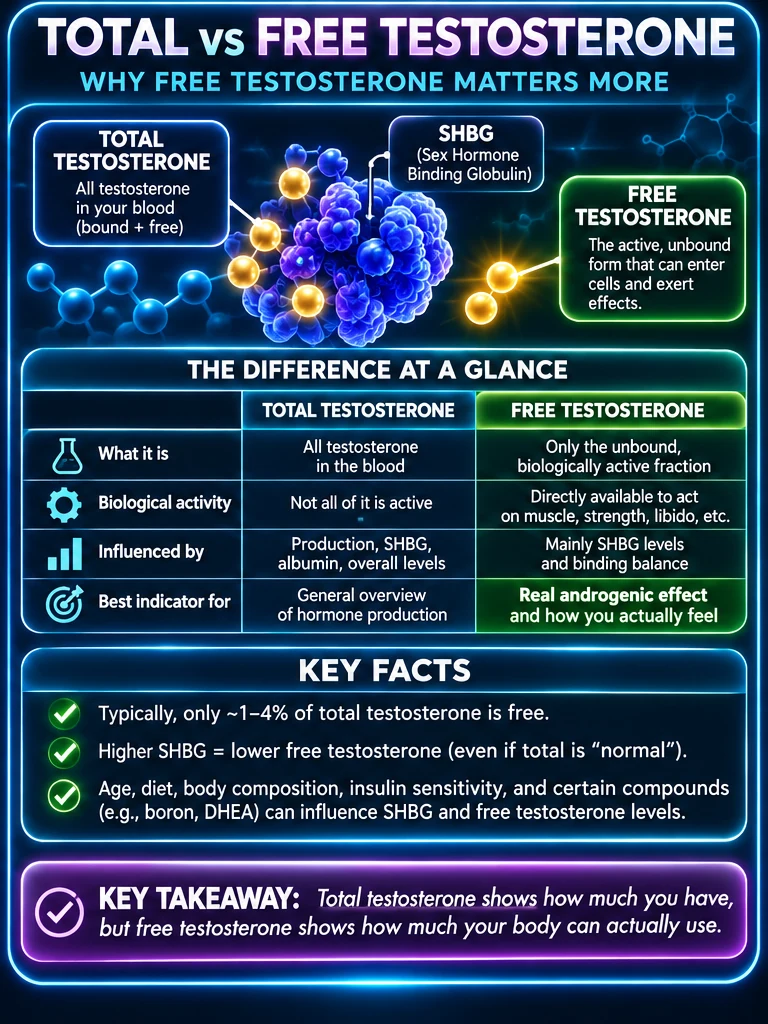
Two men may have similar total testosterone results yet different levels of free testosterone. Does that mean the free value is always the better test? No: both measurements matter, and symptoms, sampling conditions and assay quality matter too.
1. What is total testosterone?
Total testosterone includes testosterone bound tightly to sex hormone-binding globulin (SHBG), testosterone loosely bound to albumin, and a small unbound or free fraction. Most circulating testosterone is protein-bound. Total testosterone is usually the first laboratory measurement used when evaluating possible deficiency.
2. What is free testosterone?
Free testosterone is the unbound fraction. It is commonly estimated at around 1–3% of total testosterone, although the exact percentage varies. Albumin-bound testosterone can also dissociate and become available to tissues; therefore, describing only free testosterone as biologically active is an oversimplification.
3. Why SHBG matters
SHBG changes how much testosterone is bound in circulation. SHBG can vary with age, thyroid function, liver conditions, body composition, insulin resistance and some medications. When SHBG is unusually high or low, total testosterone alone can be misleading.
4. Which laboratory test is most useful?
Clinical guidelines generally recommend diagnosing testosterone deficiency only when consistent symptoms occur together with unequivocally and repeatedly low testosterone concentrations. Testing is usually performed on separate mornings, ideally using a reliable assay. When total testosterone is near the lower limit or SHBG is altered, free testosterone assessed by equilibrium dialysis or a validated calculation may provide additional information. Some direct analogue free-testosterone immunoassays are unreliable.
5. What about strength, libido and recovery?
Testosterone influences sexual function, body composition, bone health and other systems, but a single laboratory number does not predict how someone feels or performs in the gym. Sleep, energy availability, training, medications, illness and psychological factors can also affect symptoms.
6. Why chasing higher numbers can backfire
For men without confirmed deficiency, adding testosterone is not a proven shortcut to better wellbeing. Exogenous testosterone can suppress sperm production and carries other risks. Products marketed as SHBG “hacks” or testosterone boosters frequently overstate the evidence; changing a binding-protein number does not automatically improve health.
Research and clinical guidance
- Bhasin S et al. Testosterone Therapy in Men With Hypogonadism: An Endocrine Society Clinical Practice Guideline. Journal of Clinical Endocrinology & Metabolism (2018). DOI.
- European Association of Urology. Guidelines on Sexual and Reproductive Health (current online edition).