Stomach Acid
Anything swallowed sits in an acidic environment built to break down food — including proteins and peptides. Many active compounds are partially degraded before they even leave the stomach.
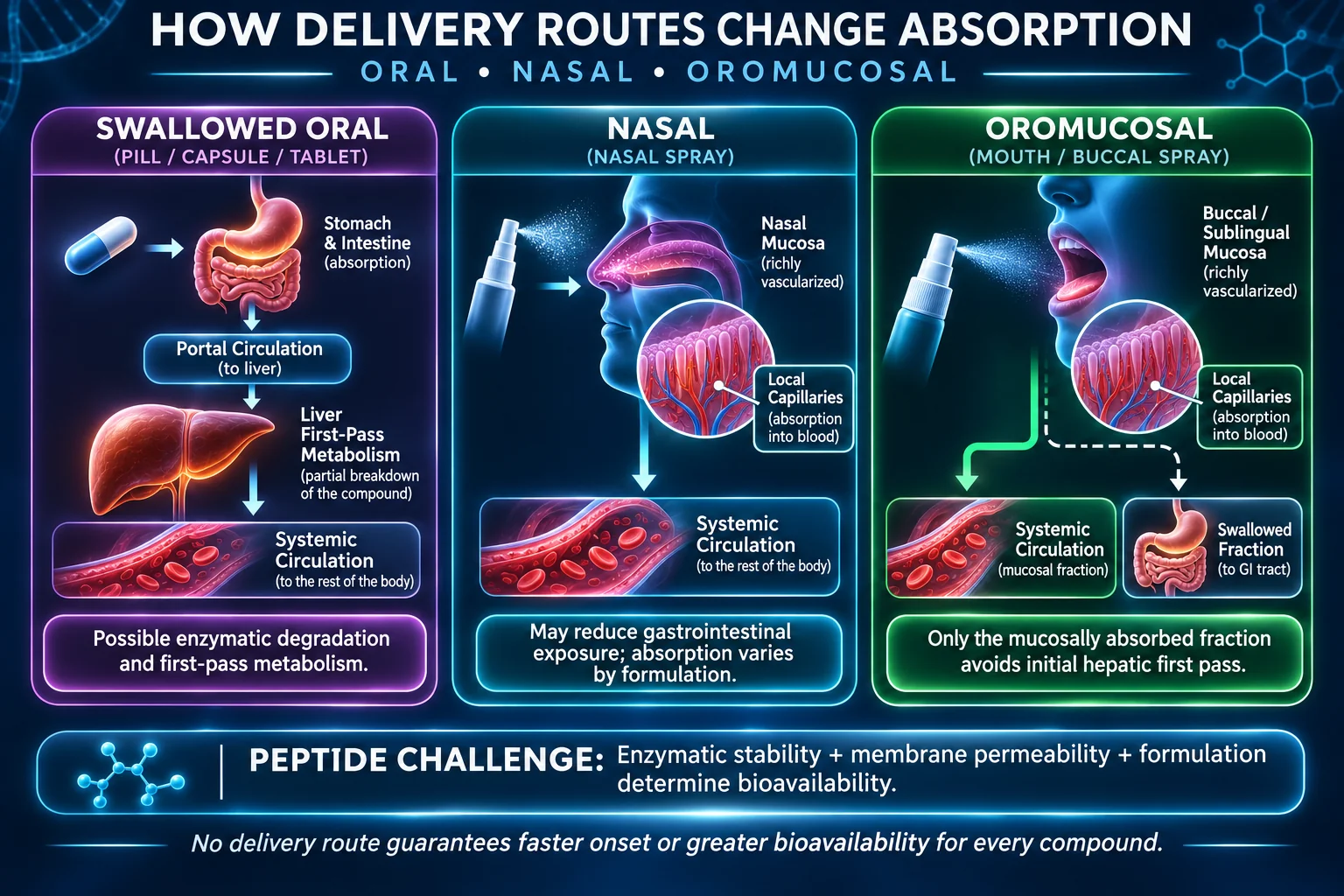
Drug delivery routes can change absorption, onset and bioavailability. The original TigerBlood overview below has been retained and clarified where results depend on the molecule or formulation.
Swallowed oral doses have to survive stomach acid and then run the gauntlet of the liver's first-pass metabolism before a single molecule reaches the bloodstream — a combination that can reduce the amount of some active ingredients reaching systemic circulation. Nasal and oral mucosal routes can avoid gastrointestinal degradation and some first-pass metabolism when the compound is actually absorbed through the mucosa.
Not all of a dose makes it into your bloodstream. How much survives — and how fast it arrives — depends on the active ingredient, its formulation, and the route of administration.
Anything swallowed sits in an acidic environment built to break down food — including proteins and peptides. Many active compounds are partially degraded before they even leave the stomach.
Whatever survives the stomach is absorbed into blood that flows directly to the liver before reaching the rest of the body. The liver's enzymes are designed to neutralize foreign compounds, and a significant portion of the original dose is metabolized here before it ever reaches general circulation.
Stacked together, acid breakdown and first-pass metabolism are the reason oral bioavailability can be low for certain compounds. Dose equivalence and onset cannot be assumed across routes without formulation-specific studies.
The nasal cavity is lined with a thin, richly vascularized mucous membrane — a direct, short route into the bloodstream.
The nasal mucosa sits directly over a dense network of blood vessels. Compounds absorbed here pass straight into systemic circulation, without first crossing the stomach or the liver.
Because the path to the bloodstream is so short, some nasally delivered compounds may act faster than swallowed formulations, although onset depends on the compound and formulation.
Nasal delivery offers a route that avoids both the degradation problems of swallowing and the practical downsides of injection — no needles, no injection-site reactions.
An oral spray doesn't mean swallowing — it means absorption straight through the lining of the mouth, potentially reducing gastrointestinal exposure when absorption occurs through the oral mucosa.
The inside of the cheek (buccal) and the underside of the tongue (sublingual) are also lined with thin, blood-vessel-rich mucosa, allowing compounds to pass directly into the bloodstream when held in the mouth rather than swallowed.
The fraction absorbed through the oral mucosa can avoid gastrointestinal degradation and initial hepatic first-pass metabolism; any swallowed fraction may not.
A properly validated metered spray can offer convenient dosing, without special training or equipment.
Peptides are chains of amino acids — and that structure makes them particularly vulnerable to the oral route.
The same digestive enzymes that break down the protein in food (pepsin, trypsin, and others) do not distinguish between dietary protein and a peptide active ingredient. Swallowed peptides are frequently broken down into inactive fragments before absorption.
Because oral bioavailability for most peptides is so low, injection has historically been the standard route — it bypasses digestion entirely by delivering the compound straight into tissue or bloodstream.
Nasal and oral mucosal sprays occupy a middle ground: they may reduce gastrointestinal exposure and first-pass metabolism for the absorbed fraction, but many peptides still face major permeability and stability challenges.
This article introduces the underlying mechanisms. Claims about any particular formulation require product-specific pharmacokinetic evidence.
Explore more practical discussions about training, nutrition, recovery and lifestyle in our Coach's Corner.
Visit Coach's Corner →