1. Erection Is Not the Same as Orgasm
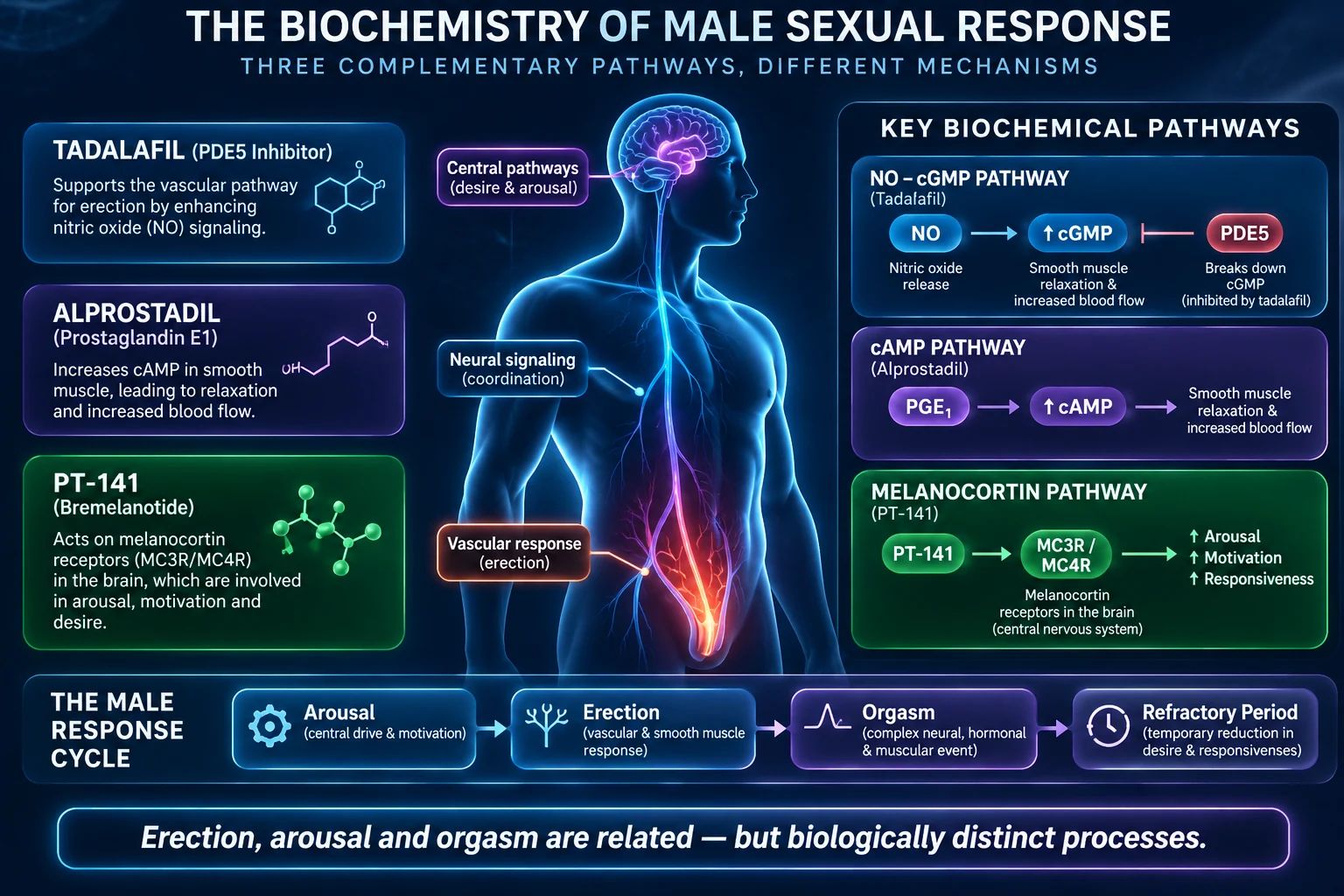
Erection is a neurovascular response. Sexual stimulation promotes nitric oxide (NO) release, activating soluble guanylate cyclase and increasing cyclic GMP (cGMP). This relaxes smooth muscle in the corpus cavernosum, increases blood inflow and reduces venous outflow. PDE5 breaks down cGMP, helping regulate this response.
Orgasm, by contrast, is a complex sensory and neurological experience involving the brain, spinal cord and pelvic muscles. Ejaculation and orgasm often occur together, but they are not identical. An erection can persist without orgasm, and orgasm can occur with little or no ejaculation.
2. Why Does Desire or Responsiveness Drop After Orgasm?
After orgasm, many men enter a refractory period during which another orgasm is difficult or temporarily impossible. Sympathetic nervous activity contributes to penile detumescence, while central neural circuits regulate sexual motivation and orgasmic responsiveness.
Dopamine is involved in motivation and reward; serotonin modulates ejaculatory pathways; oxytocin participates in sexual responses. Prolactin may rise after orgasm, but evidence does not establish it as the single cause of the refractory period. Testosterone supports libido and sexual health over time, but is not an immediate on/off switch for erection.
Loss of erection and inability to achieve another orgasm are related but distinct phenomena.
3. Tadalafil: Faster Erectile Recovery, Not Unlimited Orgasms
Tadalafil inhibits PDE5 and can make it easier to obtain or regain an erection when sexual stimulation is present. Some users describe faster recovery of erection after ejaculation. Small studies of sildenafil, a related PDE5 inhibitor, have investigated post-ejaculatory recovery, but results cannot be assumed to apply equally to tadalafil or to every individual.
Even with adequate erection, the next orgasm may take longer or remain difficult to achieve. Supporting blood flow does not automatically reset central orgasmic responsiveness.
4. Alprostadil: Erection Without the Usual Dependence on Arousal
Alprostadil (Caverject) is a prostaglandin E1 analogue that increases cAMP signaling and relaxes penile smooth muscle. When injected into erectile tissue under medical supervision, it can produce an erection without the same requirement for sexual stimulation as PDE5 inhibitors.
In one anonymized personal account discussed in preparing this article, an alprostadil-supported erection coincided with three successive orgasms during one intimate encounter. The third was described as particularly intense; ejaculation at that point was uncertain. Strong mutual arousal and the partner's involvement were central parts of the experience.
This is an anecdote, not proof that alprostadil causes multiple orgasms or intensifies orgasm. It illustrates a research question: when erectile rigidity persists, can continued stimulation sometimes allow additional orgasms?
Alprostadil is not a routine enhancement method for men with normal erections. Penile pain, bleeding, fibrosis and priapism are meaningful risks. An erection lasting four hours requires emergency medical attention.
5. Dapoxetine: Delaying Ejaculation Can Also Make Orgasm Harder
Dapoxetine is a short-acting SSRI used in some countries to treat premature ejaculation. It changes serotonergic signaling and can delay ejaculation, but some users experience marked difficulty reaching orgasm despite maintaining an erection.
This contrast is instructive: extending intercourse does not necessarily increase satisfaction. Treatment for premature ejaculation addresses a different clinical goal from enabling additional orgasms.
6. PT-141 (Bremelanotide): A Central Pathway
Bremelanotide, also known as PT-141, is a synthetic peptide that acts on melanocortin receptors involved in central sexual arousal. In contrast, tadalafil primarily supports peripheral erectile physiology.
A small 2005 study evaluated intranasal PT-141 together with sildenafil in men with erectile dysfunction and reported an enhanced erectile response. It did not demonstrate that PT-141 plus tadalafil produces multiple orgasms, eliminates the refractory period or safely reproduces alprostadil's effects.
Bremelanotide is approved in the United States for a defined form of hypoactive sexual desire disorder in premenopausal women, not for male sexual performance. Important risks include nausea, transient blood pressure increases and heart-rate changes. It should not be combined experimentally with erectile medications without medical supervision.
7. Are Multiple Male Orgasms Possible?
Yes. Published reports describe some men experiencing multiple orgasms, sometimes without ejaculation. This is not typical for everyone and the mechanisms are not fully understood.
Repeated ejaculations over a short period often produce progressively less semen, but semen volume is not a reliable measure of orgasm intensity. Most semen volume comes from accessory glands, while sperm are produced continuously in the testes.
Partner interaction, sensory input, psychological context and emotional connection also influence the overall experience. Medication cannot reproduce these interpersonal factors on its own.
8. What Should Future Research Investigate?
The most useful questions may be how quickly orgasmic responsiveness recovers, why refractory periods vary so widely, and how central arousal pathways interact with peripheral erectile mechanisms. Melanocortin, dopaminergic and serotonergic pathways are scientifically interesting, but they are not established routes to reliably producing multiple orgasms in healthy men.
More pharmacological stimulation is not always better. Just as testosterone treatment is not automatically beneficial in men with normal testosterone levels, combining drugs with complementary mechanisms is not automatically safe or effective.
Future studies should measure not only erection rigidity and time to the next orgasm, but also subjective satisfaction, adverse effects and the role of partner interaction. No approved treatment is currently proven to safely and reliably abolish the male refractory period.
Selected Research and Clinical Resources
- Andersson KE. Mechanisms of penile erection and basis for pharmacological treatment of erectile dysfunction. Pharmacological Reviews (2011). PubMed search.
- Diamond LE et al. Co-administration of low doses of intranasal PT-141 and sildenafil to men with erectile dysfunction. Urology (2005). PubMed search.
- European Association of Urology. Sexual and Reproductive Health Guidelines.
- U.S. Food and Drug Administration. Drug approval and prescribing information database (Vyleesi / bremelanotide).